A new school year often starts with fresh notebooks, new teachers, and renewed expectations. For some students, however, the same academic frustrations return with them. A child may spend hours on homework, study carefully for a test, or participate actively in class, yet the grades still do not reflect the effort being made.
Parents may hear comments such as “needs to work harder” or “should be more organized,” but those explanations do not always tell the full story. Sometimes, the more important question is not how much a student is trying, but how that student learns.
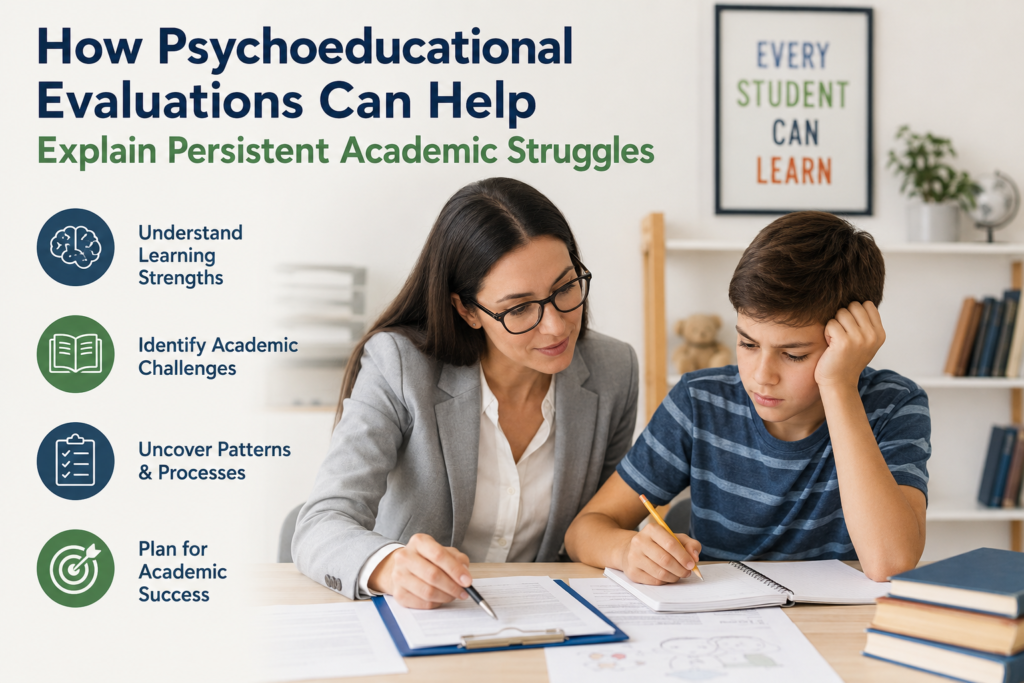
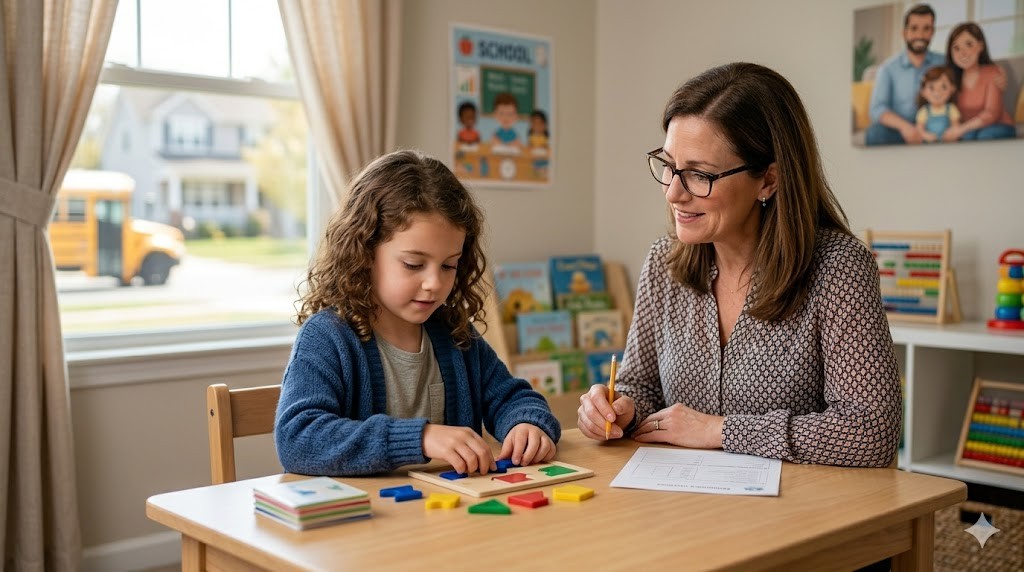
This is where psychoeducational evaluations in Bryn Mawr can become an important step. A thoughtful evaluation can look beyond surface-level academic performance and provide a clearer picture of a student’s learning strengths, challenges, and patterns.
Table of Contents
ToggleWhen Effort Is Not the Problem
Imagine a student who spends two hours completing an assignment that classmates finish in thirty minutes. The student understands the lesson but struggles to put answers on paper quickly. Another child reads every assigned page but remembers surprisingly little of what was read. A third student performs well in class discussions but struggles significantly on written tests.
From the outside, these situations may simply look like inconsistent school performance.
From a closer perspective, they can raise important questions.
Academic difficulties can have different underlying patterns, and those patterns may not be obvious from report cards alone. A psychoeducational evaluation can help examine the skills involved in learning so that parents can better understand what may be contributing to a student’s experience.
The purpose is not to search for something wrong with the child. It is to understand the child more accurately.
The Start of a School Year Can Reveal What Last Year Did Not
Back-to-school season creates a natural point for reflection. Parents often look at the previous year’s grades and wonder whether the same problems will continue.
That question matters because academic demands tend to increase as students move through school. Reading becomes more complex. Written assignments become longer. Mathematics requires more abstract thinking. Tests may require students to process and recall larger amounts of information.
A student who managed reasonably well in an earlier grade may suddenly begin struggling when expectations change.
An evaluation can help families examine areas such as:
- Cognitive and reasoning abilities
- Academic achievement
- Reading, writing, and mathematics skills
- Processing and memory abilities
- Patterns of strengths and weaknesses
- Differences between expected and actual academic performance
These areas can be considered together rather than viewed as isolated test scores.
What If the Grades Are Telling Only Half the Story?
Grades are useful, but they do not always explain why a student is performing at a particular level.
Two students can receive the same grade for completely different reasons. One may understand the material but struggle with the speed of completing assignments. Another may need more direct instruction in a specific academic skill. A third may perform inconsistently because certain types of tasks are much harder than others.
This is why evaluation findings are interpreted as a whole.
A student’s strengths can be just as important as areas of difficulty. Strong verbal reasoning, visual abilities, memory, or problem-solving skills may provide valuable context for understanding areas that are more challenging.
The resulting picture can be much more meaningful than simply saying that a student is “good” or “bad” at a subject.
The Right Questions Can Be More Valuable Than More Pressure
When a child struggles academically, the instinct may be to add more practice, more tutoring, or more hours of homework. Sometimes additional instruction is useful. But if the reason for the difficulty is not understood, adding more work may not address the underlying issue.
A psychoeducational evaluation can help families ask more useful questions.
Is the student having difficulty with a particular academic skill? Is there a noticeable difference between cognitive ability and academic achievement? Are certain tasks consistently more demanding? Does the student’s performance change depending on the type of assignment?
These questions shift the conversation away from blame and toward understanding.
A Better School Plan Starts With Understanding the Student
Evaluation results can provide information that families may use when discussing a student’s educational needs with the school. Rather than approaching teachers with only a general concern that a child is struggling, parents may have a clearer understanding of the specific patterns identified through assessment.
That information can be especially valuable before a major academic transition.
For example, moving from elementary school to middle school often means managing multiple teachers, larger assignments, increased reading demands, and greater independence. Moving into high school can bring even more complex academic expectations.
Understanding a student’s learning profile before these demands increase can give families a stronger foundation for planning.
Preparing for an Evaluation Is Part of Preparing for School
A psychoeducational evaluation does not begin when testing starts. Parents can provide useful background by gathering information that shows how the student has performed over time.
Helpful records may include:
- Previous report cards and progress reports
- Teacher observations or concerns
- Standardized testing results
- Samples of schoolwork
- Previous assessment reports
- Information about subjects that have consistently been difficult
Parents should also think about what prompted their concerns. A specific question can often provide valuable direction for the evaluation process.
Perhaps reading has become increasingly difficult. Maybe writing assignments take much longer than expected. Perhaps a student understands lessons but cannot demonstrate that knowledge during tests.
Those details matter because they help create a fuller picture of the student’s academic experience.
The Goal Is Clarity, Not Simply a Label
For many families, the most useful outcome of an evaluation is a better understanding of what their child needs.
Testing should not reduce a student to a collection of numbers. It should help explain patterns that parents and educators may already be noticing but cannot fully understand.
A strong evaluation considers the individual behind the results. It looks at abilities, academic performance, areas of relative strength, and areas that may require closer attention.
That perspective can help families move forward with more informed educational decisions rather than continuing to guess at the source of academic difficulties.
Give the Next School Year a More Informed Starting Point
A new school year does not have to mean repeating the same academic struggles without understanding them. When concerns have persisted despite effort, an evaluation can provide another way to look at the situation.
Comprehensive Neuropsychology Services offers comprehensive evaluation services for families seeking a clearer understanding of learning, cognitive functioning, and academic performance. Psychoeducational evaluations can help examine a student’s cognitive and academic profile and provide meaningful information for educational planning.
Families seeking a broader understanding of academic performance can also explore academic evaluation services in Bryn Mawr as they prepare for the demands of a new school year.
Start the School Year With Better Answers
Every student brings a different combination of strengths, learning preferences, and academic challenges into the classroom. When school performance does not seem to match effort or ability, simply asking a student to try harder may not provide the answer. Sometimes, the better starting point is understanding what is happening beneath the grades.
For families concerned about academic progress, Comprehensive Neuropsychology Services provides evaluation services designed to bring greater clarity to the learning process. A psychoeducational evaluation may help families better understand a student’s cognitive and academic profile and determine what information may be useful for educational planning.
Contact Comprehensive Neuropsychology Services to discuss whether a psychoeducational evaluation may be an appropriate next step.